

Today’s post comes from a discussion with the founders of Bitsage Network. I also learned a lot about the fundamental engine of AI technology - the GPU networks that provide the computing power AI needs to operate.
Modern technologies, combined with AI, are enabling decentralized compute networks where anyone can contribute by connecting their home GPU.
To understand how these networks operate, we need to know how validators, GPUs, utilization, and capital investment interact over time.
What is a validator?
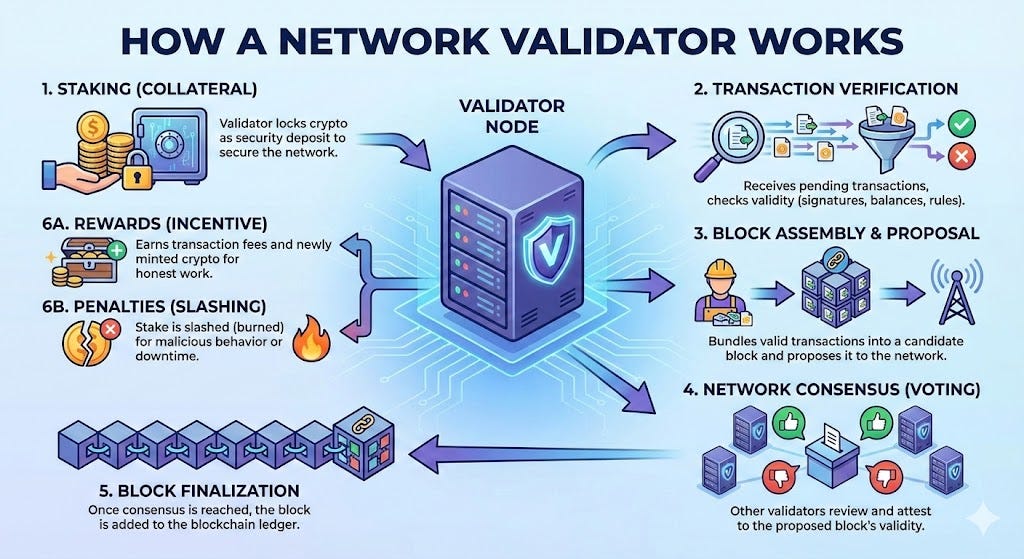
At the core of a decentralized GPU network is a validator.
A validator is not a “user” in the traditional sense. It’s best thought of as:
A GPU node connected to the network
A provider of computation
An entity incentivized through token rewards
If you’ve ever looked at Bitcoin mining, the analogy is close, but instead of hashing blocks, validators provide real GPU computation and submit proofs that the work was done correctly.
This matters because capacity comes before demand.
You cannot serve customers without available GPUs. There is no abstraction layer that changes this reality.
Validators come first. Customers follow.
One of the most important insights is simple but often misunderstood:
Validators must exist before customers can scale.
The network grows in parallel, but the order matters:
Validators join and provide GPUs
The network gains capacity
Customers can now use that capacity
If the network has 100 GPUs, it can serve roughly 100 customers concurrently. You cannot grow beyond your available compute supply.
This makes validator growth the primary leading indicator of network growth.
Network utilization
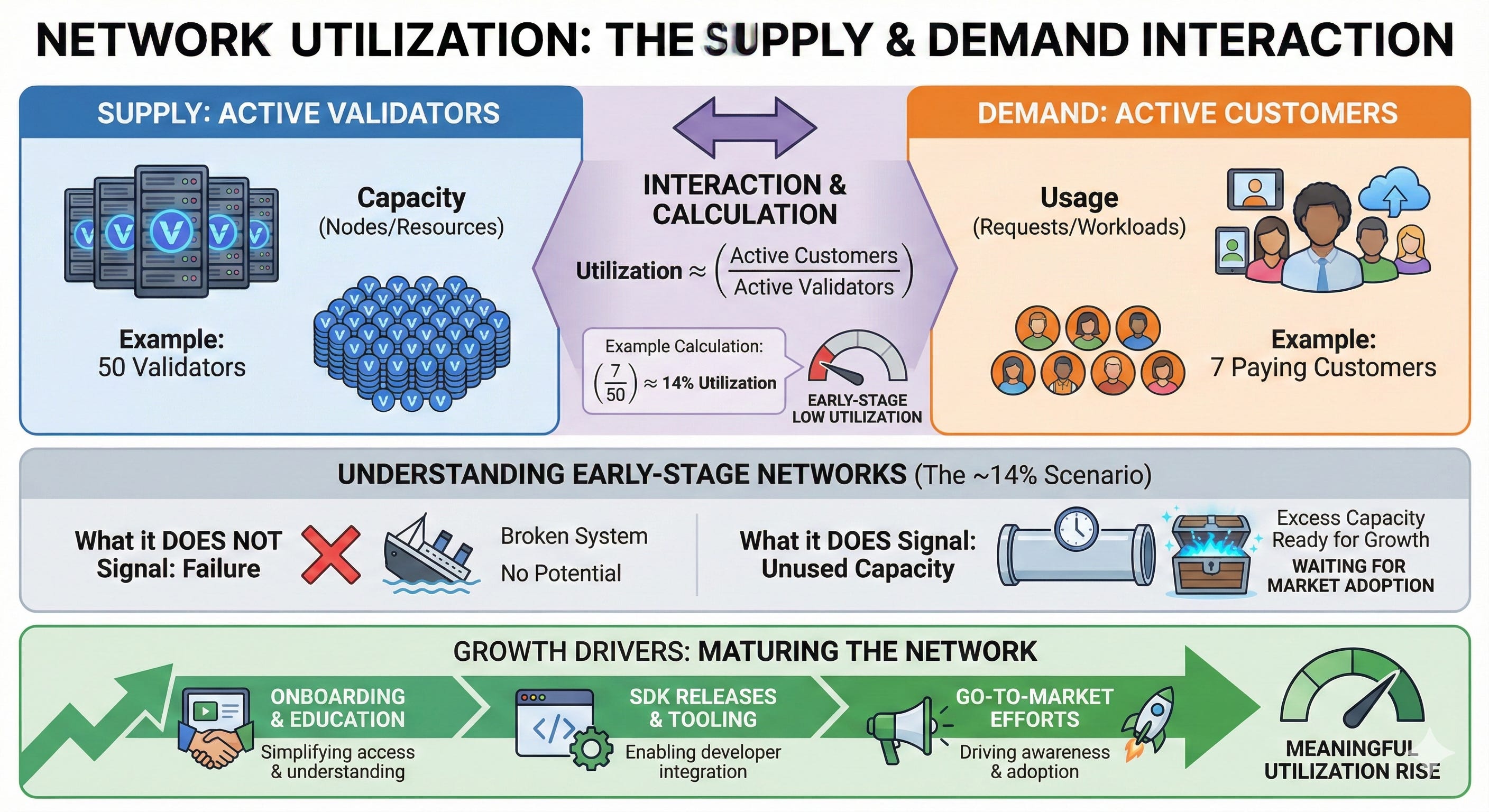
Utilization is often misunderstood as a single number. In reality, it’s the interaction between:
Active validators (supply)
Active customers (demand)
Early-stage networks often show low utilization, and that’s normal.
For example:
50 validators
7 paying customers
→ ~14% utilization
This does not signal failure. It signals unused capacity waiting for market adoption.
Utilization only rises meaningfully after onboarding, SDK releases, and go-to-market efforts mature.
Compute growth and its constraints
Decentralized compute markets grow fast—but not infinitely.
There are real constraints:
GPUs are physical assets
Global GPU supply is finite
Validator onboarding takes time
When modeling growth, it’s tempting to extrapolate exponential curves indefinitely. That’s how unrealistic projections appear (millions of validators in short timeframes).
How capital actually changes network dynamics
Capital enables:
Validator incentives
Marketing and community growth
Liquidity provisioning
Infrastructure and operations
In decentralized networks, capital injections often correlate with temporary acceleration, not permanent growth rates.
This creates a recognizable pattern:
Spike after funding
Gradual normalization
Stable long-term growth
Modeling this correctly prevents overstating future adoption.
Expense structure mirrors technical maturity
Another key lesson: expenses should follow product maturity.
Early stage:
Heavy core development
High R&D intensity
Minimal marketing
Mid stage:
Development stabilizes
Operations and compliance appear
Validator onboarding ramps
Growth stage:
Go-to-market becomes dominant
Partnerships and ecosystem expansion accelerate
R&D focuses on defensibility (e.g., cryptography, privacy, ZK proofs)
Flattening expenses across time hides this reality and distorts cash flow analysis.
Competitive context matters
Decentralized GPU networks don’t exist in isolation.
Major players in this space include:
Many of these projects reached multi-billion-dollar valuations—but none started there. Early rounds were often small, focused on proving:
Technical feasibility
Validator demand
Early utilization
The pattern is consistent: validate first, scale later.
Decentralized GPU networks are not magic
Decentralized GPU are systems governed by:
Physical hardware constraints
Incentive alignment
Capital timing
Network effects
Understanding validators, utilization, and growth mechanics is far more important than tracking token prices or headline metrics.
If you get those fundamentals right, everything else becomes easier to reason about.